I am learning flutter from JustAcademy, They provide very much great environment where people gather and work simultaneously. totally project based training institute.
MOHD ABU BAKAR ANSARI
Flutter Developer
Awesome Experience. I am a Front-end Web Designer working at Star India for 3 years now. I applied for Full-stack development and my experience has been phenomenal & they really do help with placements exceptionally. Thank you Roshan sir so much.
Javatpoint Java Tutorial – Complete Core & Advanced Java Topics, Honest Review & What to Do After
Published by JustAcademy | Updated April 2025 | 12 min read
Table of Contents
What is Javatpoint?
Complete Core Java Topics Covered on Javatpoint
Complete Advanced Java Topics Covered on Javatpoint
Is Javatpoint Enough to Learn Java? — Honest Review
What Javatpoint Does Not Teach You
How to Use Javatpoint Effectively
What to Do After Javatpoint — Next Steps
FAQ
What is Javatpoint?
Javatpoint is one of India's most visited free programming tutorial websites, covering over 200 technology subjects. For Java learners specifically, it has been a go-to reference since 2011 — offering topic-wise explanations, code examples, and interview question lists for both Core Java and Advanced Java.
If you landed here searching for javatpoint java tutorial, javatpoint core java notes, javatpoint advanced java topics, or simply wondering is javatpoint good for learning java — you are in the right place. This guide covers everything from the full syllabus to an honest review and a clear roadmap after you finish.
Complete Core Java Topics Covered on Javatpoint
Here is the full Core Java syllabus available on Javatpoint, which is also the standard syllabus followed in most Java developer interviews:
Complete Advanced Java Topics Covered on Javatpoint
Once students finish Core Java, Javatpoint also covers the following Advanced Java topics — which are essential for backend developer, full-stack Java, and enterprise application roles:
Spring Boot with REST API — GET, POST, PUT, DELETE
Spring Data JPA basics
application.properties configuration
Spring Boot with MySQL
Spring Boot Actuator basics
Important Note: Javatpoint's Spring Boot coverage is introductory only. For production-level Spring Boot development including Microservices, Spring Security, JWT Authentication, and REST API best practices — structured hands-on training is strongly recommended.
Java Networking — Socket and ServerSocket programming
Java NIO — Non-blocking I/O, Channels, Buffers
Java AWT — Abstract Window Toolkit
Java Swing — desktop GUI development
Java Applet — (legacy, not used in modern development)
Regular Expressions in Java
Internationalization (i18n) in Java
This is the complete javatpoint advanced java syllabus covering everything from database connectivity with JDBC to enterprise frameworks like Spring and Hibernate.
Is Javatpoint Enough to Learn Java? — Honest Review
This is the most common question asked by students across Quora and Reddit: is javatpoint enough to learn java for a job?
The honest answer is — it depends entirely on what you want to do with Java.
Where Javatpoint is genuinely useful:
Quick concept revision before exams or interviews
Understanding definitions and Java syntax clearly
Checking Java interview questions topic by topic
Reference material when you forget a specific method or class
Completely free with no account or payment required
Where Javatpoint falls short:
Most reviews of Javatpoint from working developers and students point out the same gaps. The content is theoretical. You read how inheritance works, but you never actually build a project using it. There are no assignments, no live doubt-solving, no feedback on your code. As one widely upvoted Quora answer puts it — "Javatpoint is like a dictionary — good for reference, not for learning from scratch."
Another common complaint is the heavy advertisement load. The site shows multiple ads per page which interrupts reading and makes focused study on mobile very difficult.
Rating summary based on public reviews:
Area
Rating
Notes
Content clarity
⭐⭐⭐⭐ 4/5
Well explained for beginners
Topic depth
⭐⭐⭐ 3/5
Some advanced topics are incomplete
Practical projects
⭐ 1/5
Almost none
Interview prep
⭐⭐⭐⭐ 4/5
Good question lists
Updated content
⭐⭐ 2/5
Many pages still on older Java versions
Overall
⭐⭐⭐ 3.3/5
Good reference, not a complete course
What Javatpoint Does Not Teach You
If your goal is to get a Java developer job, here is what you will NOT get from Javatpoint alone:
1. Real project experience — Employers ask to see GitHub repositories and deployed projects. Javatpoint has no guided project work at all.
2. Live doubt solving — When you are stuck on a concept at 11pm before an interview, there is no one to ask.
3. Code review and feedback — Writing code that runs is one thing. Writing clean, efficient, interview-ready code is a completely different skill that only comes from expert feedback.
4. Structured learning path — Javatpoint is a collection of individual articles, not a course. It is easy to skip important topics without realising it, which creates gaps that show up in interviews.
5. Placement preparation — Resume building, mock technical interviews, HR round preparation, LinkedIn profile — none of this exists on Javatpoint.
6. Spring Boot and Microservices depth — Javatpoint's Spring Boot coverage is very basic. Modern Java job descriptions require Spring Boot, REST APIs, Microservices, and Spring Security — none of which Javatpoint covers in sufficient depth.
7. Updated Java versions — Many pages on Javatpoint still reflect Java 8 and have not been updated for Java 17 or Java 21 LTS features that interviewers now ask about.
How to Use Javatpoint Effectively
If you are currently studying from Javatpoint, here is how to get the maximum value from it:
Follow the topic order shown in the left-side menu exactly — do not jump around randomly
Run every code example in your own IDE — never just read it
After reading each topic, close the page and write the code from memory
Use Javatpoint for concept understanding, then solve related problems on HackerRank or LeetCode
Use the interview questions section only after understanding concepts — not as a shortcut before that
Pair with YouTube videos for topics that still feel unclear after reading
Set a daily target — 2 to 3 topics per day minimum to maintain momentum
What to Do After Javatpoint — Next Steps to Become a Java Developer
After finishing the Javatpoint Java tutorial, most students hit the same wall — they know the theory but cannot build anything real on their own. Here is the exact path forward:
Step 1 — Build 2 to 3 small Java projects Start with a Student Management System, a Library Management System, or a Banking System simulation using Core Java, OOP, and Collections.
Step 2 — Learn JDBC and connect Java to a database Every backend Java role requires database connectivity. Build a small CRUD application using JDBC and MySQL.
Step 3 — Learn Spring Boot properly This is what 90% of Java job descriptions require today. Javatpoint's Spring coverage is not enough — you need hands-on training with real REST API projects.
Step 4 — Practice 50 to 100 Java interview questions with code Focus on OOP concepts, Collections internals, Exception Handling, Multithreading, and String problems — these are the most frequently asked categories in Java interviews across all companies.
Step 5 — Get expert guidance, code review, and placement support This is the step most students skip and then wonder why they are not getting interview calls despite knowing all the theory.
At JustAcademy, our Java training programs are built exactly for students who have done self-study on platforms like Javatpoint and now need real-world projects, expert mentorship, and placement support to land their first developer role.
Core Java Training at JustAcademy includes:
Complete Core Java — structured week by week from basics to advanced
Real-time projects with code review from industry mentors
100+ Java interview questions with full mock interview sessions
Resume building and LinkedIn profile guidance
Placement assistance with direct company referrals
Q: What is Javatpoint and is it free? Javatpoint is a free online tutorial platform covering Java, Python, C++, web development, and over 200 other technology topics. It is completely free — no account, no payment, and no subscription is needed to access any tutorial.
Q: Is Javatpoint enough to learn Java for a job? For understanding concepts and revising before interviews, Javatpoint is useful. However, it does not provide live projects, code feedback, doubt solving, or placement preparation — all of which are essential to actually getting hired as a Java developer. Most working developers recommend pairing Javatpoint with hands-on training.
Q: Is Javatpoint good for Java interview preparation? Yes — the interview questions section on Javatpoint is one of its strongest features. It lists commonly asked Java questions topic-wise and is widely used for quick revision. However, companies today ask you to write code on screen, explain your project, and solve logic problems — for which reading question lists alone is not enough.
Q: What is the best alternative to Javatpoint for learning Java? For structured learning with projects, alternatives include the official Oracle Java documentation, Baeldung for Spring and Java 8+ topics, and structured training programs that combine live mentorship, real projects, and placement support. JustAcademy's Core Java and Advanced Java training programs are specifically designed for this.
Q: Does Javatpoint cover Java 8 features like Stream API and Lambda Expressions? Yes, Javatpoint has dedicated pages for Java 8 features including Lambda Expressions, Stream API, Functional Interface, and the new Date and Time API. However, the coverage is introductory and does not include practical project-level usage which interviewers commonly test.
Q: Does Javatpoint cover Spring Boot? Javatpoint covers Spring Boot at an introductory level — basic setup, REST controllers, and Spring Data JPA. It does not cover Spring Security, JWT, Microservices, or production-level REST API development in sufficient depth for job requirements.
Q: How long does it take to complete the Javatpoint Java tutorial? If you study 3 to 4 hours daily, completing all Core Java topics on Javatpoint typically takes 4 to 6 weeks. Advanced Java topics including Servlet, JDBC, Hibernate, and Spring basics take an additional 4 to 6 weeks. Total self-study time is roughly 10 to 12 weeks for both combined.
Q: Is Javatpoint content accurate and up to date? Javatpoint content is generally accurate for Core Java concepts. However, some Advanced Java pages and Spring content have not been updated for recent versions. Javatpoint's Spring Boot coverage does not reflect current Spring Boot 3.x practices. Always cross-check with official documentation for framework-specific topics.
Q: What should I learn after completing Javatpoint Core Java? After Core Java, the recommended path is: JDBC for database connectivity, then Servlets and JSP for web basics, then Hibernate for ORM, then Spring Framework fundamentals, and then Spring Boot for REST API development. This full path is covered in JustAcademy's Advanced Java Training.
Q: What Java topics are most important for interviews? Based on actual interview patterns across companies, the most frequently tested topics are: OOP concepts with real code examples, Collections internals (how HashMap works, difference between ArrayList and LinkedList), Exception Handling, Multithreading and Synchronization, String manipulation problems, Java 8 Stream and Lambda, and JDBC or Spring Boot depending on the role level.
Q: Can I get a Java developer job without formal training? It is possible but significantly harder. Most self-taught candidates struggle at the project explanation round and coding assessment. Structured training gives you real projects, interview-specific preparation, and placement connections that self-study platforms like Javatpoint cannot provide.
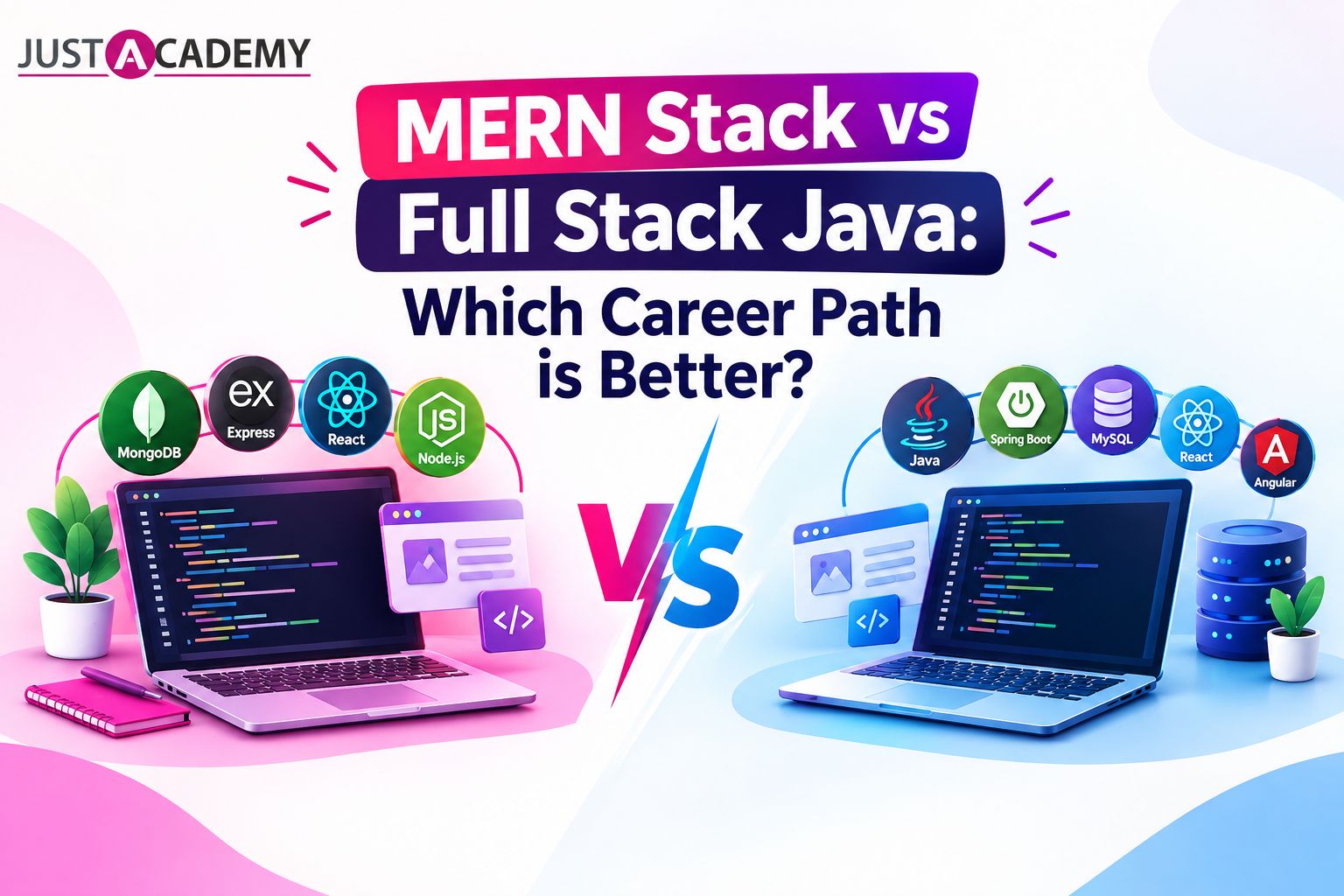
A practical comparison for Pune based learners choosing between MERN and Java full stack development, covering salary, learning curve, job roles, and long term career growth.